

* Trading is risky. Capital at risk.




Tuesday. 3rd November
US midterm elections open
When the elections take place in your time zone
| Stage | US Eastern | UK | Saudi Arabia, Qatar (UTC+3) | UAE, Oman (UTC+4) | Singapore, Hong Kong (UTC+8) |
|---|---|---|---|---|---|
First polls close, parts of Indiana and Kentucky | Tue 18:00 | Tue 23:00 | Wed 02:00 | Wed 03:00 | Wed 07:00 |
Polls close across most of the East Coast | Tue 19:00 to 20:00 | Wed 00:00 to 01:00 | Wed 03:00 to 04:00 | Wed 04:00 to 05:00 | Wed 08:00 to 09:00 |
West Coast closes | Tue 23:00 | Wed 04:00 | Wed 07:00 | Wed 08:00 | Wed 12:00 |
Alaska and Hawaii close | Wed approx 01:00 | Wed approx 06:00 | Wed approx 09:00 | Wed approx 10:00 | Wed approx 14:00 |
Does congress move the dollar?
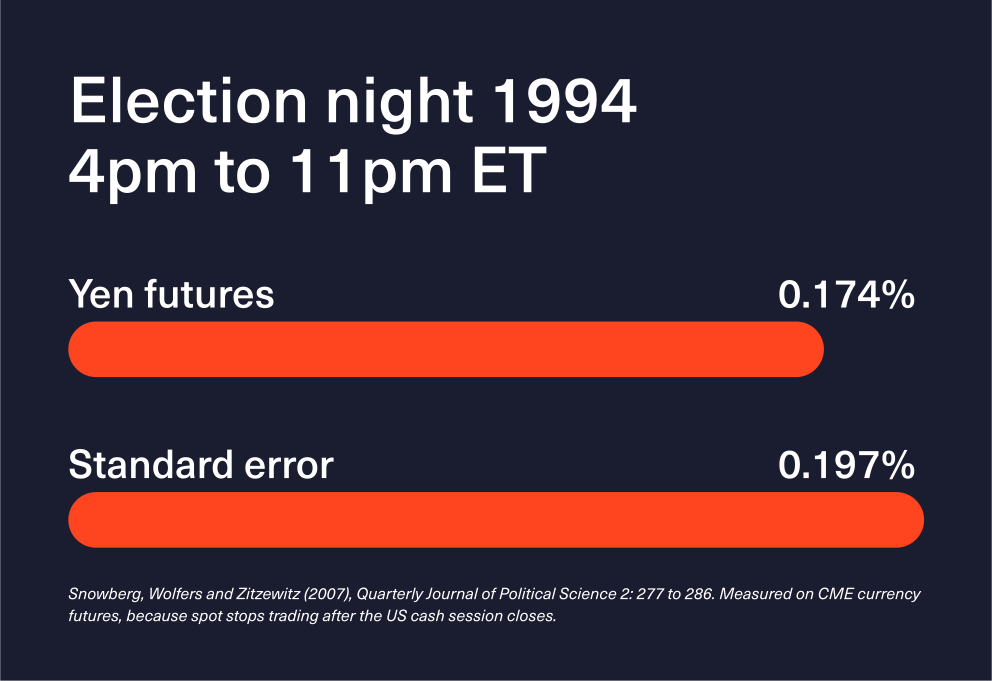
On election night in 1994, Republicans took both chambers of Congress. Between 4pm and 11pm Eastern, yen futures moved 0.174%. The standard error on that measurement was 0.197%. The move was smaller than the noise around it.
During the 2002 and 2006 midterms, moves across the euro, the yen and the Canadian dollar were statistically indistinguishable from zero.
FX volatility tends to rise in the month before a US election, and under divided government. So what should traders do going in to the midterms?
Read our analyst's guide to find out.
How do elections impact markets?

While some pairs aren't impacted, elections do move markets. When the US goes to the polls, volatility spreads across global markets, and volatility is where traders find opportunity.
The US dollar has followed a consistent pattern through presidential cycles The S&P 500 has tended to gain in election years. But history isn't a guarantee.
Read our blog on how elections really impact markets below.
Our latest US midterm coverage

Frequently asked questions
US earnings season typically kicks off in the second week of January, April, July, and October, roughly two to three weeks after each quarter ends.
Major banks usually report first, followed by the bulk of large-cap companies over the following three to four weeks.
Most US companies report either before market open (pre-market) or after market close (post-market).
Very few report during the trading session itself as it gives the market time to digest the numbers before regular hours resume.
The Magnificent 7 refers to Apple, Microsoft, Alphabet (Google), Amazon, Nvidia, Meta, and Tesla, seven mega-cap tech stocks that make up a large share of the S&P 500's total value.
Because of their size, their earnings moves can shift the whole index, not just their own share price.
A stock's price reflects what the market already expects, not just the company's actual performance. If a company beats its earnings estimate but issues weaker guidance for the next quarter, or the beat was smaller than the market had quietly priced in, the stock can still fall.
The reaction is driven by the gap between expectation and result, not the result alone.
Liquidity typically thins out around an earnings report as market makers manage their risk ahead of an unpredictable move. Wider spreads mean higher cost to enter and exit a position, which is why position sizing around earnings needs extra care.
Some brokers and platforms allow after-hours or extended-hours trading, where most of the immediate earnings reaction happens.
Availability and liquidity in extended hours vary by platform and instrument, so it's worth checking what's actually accessible before relying on it.